 English
Amplifiers and Tuning
Trinity Radionics amplifier and tuning work focuses on RF signal handling, phase control, broadcasting concepts, and radionics instrument design.
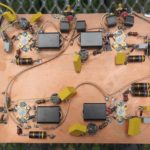
Amplifiers, Pre-Amplifiers, Balancing, and Manifestation in Radionics Instruments
After extensive experimentation, dowsing-based testing, signal measurement, and RF pre-amplifier development, Trinity Radionics selected the 5MHz to 8MHz range as a preferred operating window for certain resistance-based and air-capacitor-based radionics equipment.
While broader RF ranges can be explored in radionics-style signal work, our internal testing has focused on this range because of its perceived response, tuning behavior, and suitability for balancing-energy work, intention broadcasting, and manifestation-style radionics applications.
RF Test-Bed Development
The original test-bed was built as a wide-band amplifier platform, tunable across a broad range from approximately 1.8MHz to 180MHz. It included signal control features such as 180-degree phase shift, allowing different broadcast and tuning configurations to be explored.
Once the preferred tuning range was identified, Trinity Radionics designed and built a smaller RF signal voltage amplifier optimized around the 5MHz to 8MHz range, making it practical for integration into radionics instrument enclosures.
Radionics Amplifier Design
Trinity Radionics has developed two amplifier versions specifically for radionics applications: one focused on balancing-energy work and one focused on manifestation-style or intention-broadcasting work.
These amplifier designs include more than 60dB of gain, a 12V power input, and selectable 0-degree or 180-degree signal output inversion. In practical signal terms, 60dB of voltage gain corresponds to a voltage amplification factor of approximately 1000x.
The purpose of this amplifier stage is to support a stronger and more controlled signal path inside the radionics instrument while allowing the operator to select the desired phase relationship for the session.
Balancing and Manifestation Configurations
The balancing-energy and manifestation-oriented amplifier versions are configured differently according to their intended use. Both operate within the selected 5MHz to 8MHz tuning range, but their output networks and signal-handling approaches are adapted for different radionics applications.
In the Trinity Radionics design model, the operator’s tuning, the instrument layout, the amplifier stage, and the external antenna system work together as one broadcast chain. This chain is intended to support subtle-energy balancing, intention work, and focused radionics practice.
Output Network and Signal Theory
The amplifier output is paired with a custom capacitor and diode network designed to shape how the signal is handled before it reaches the rest of the radionics system.
The design concept draws inspiration from ideas in electronics, probability, quantum theory, entropy, and signal behavior. These references are used as conceptual and experimental inspiration for the instrument architecture, not as a claim that the device has been scientifically proven to alter physical reality.
Within the radionics model, the output network is intended to support a tuned, phase-controlled broadcast path that carries the symbolic information selected by the operator through the instrument’s rates, witness setup, antenna structure, and session intention.
Phase Shift and Broadcast Direction
Selectable 0-degree and 180-degree phase output allows the operator to choose between normal and inverted signal modes. This gives the practitioner another layer of control when setting up balancing, clearing, or manifestation-style broadcasts.
Phase control is especially useful in radionics instruments where signal polarity, broadcast direction, and antenna behavior are part of the practitioner’s method.
Why Tuning Matters
In radionics instrument design, tuning is not only about frequency selection. It also involves the relationship between the signal source, amplifier, rate system, witness well, stick pad, phase setting, antenna structure, grounding, and operator intention.
A well-tuned instrument should provide a stable, repeatable, and clear working platform for subtle-energy practice. Trinity Radionics amplifier development is focused on creating that platform through controlled RF signal handling, phase options, and carefully designed output networks.
Conceptual Papers and References
The following papers and references were used as conceptual background material during the development of the Trinity Radionics amplifier theory and design language:
-
Psychophysical Interpretation of Quantum Theory
-
Wigner’s View of Physical Reality, Michael Esfeld
-
What Every Physicist Should Know About String Theory, Physics Today
-
Quantum Theory Without Observers, Part One, Physics Today
-
Chandrasekhar vs. Eddington: An Unanticipated Confrontation, Physics Today
-
Paul Dirac and the Nobel Prize in Physics, Physics Today
-
An Atomic Physics Perspective on the Kilogram’s New Definition, Physics Today
-
Quantum Theory Needs No “Interpretation”, Physics Today
Important Notice
Trinity Radionics amplifier and tuning content is provided for radionics, symbolic, educational, and personal practice purposes. These instruments are not medical devices and are not intended to diagnose, treat, cure, or prevent any disease. Scientific references are included as background and should not be interpreted as clinical proof or guaranteed physical effects.